Welcome to a little guide I wish someone would have sent me 10 years ago (and then repeated to send me at least once a month.) Trust me, you may not crack this one in a day. But if you do end up being bi, how exciting! I think it’s a beautifully unique experience.
A lot of people struggle with the question “Am I bisexual?” Probably more than straight or gay people do. Figuring out I’m bi, certainly wasn’t a linear path for me.
Most of us grow up assuming we are straight. Not necessarily because we consciously chose that identity, but because heterosexuality is presented as the default. Then we have a crush on someone of another gender and think, okay, it all makes sense. And when things appear to make sense, we stop considering other options. (At least until they become so obvious that we can no longer claim they don’t exist.)
bisexual activist Robyn Ochs describes bisexuality as the potential to be attracted, romantically and/or sexually, to people of more than one gender. That attraction does not have to happen at the same time, in the same way or to the same degree.
In other words, bisexuality can be a lot of things. And it does not look the same for everyone.
1. Am I bisexual?
Honestly, if you found your way to this blog post, chances are you might just be bi. It is not definitive proof, but something brought you here.
When I was a teenager, I was obsessed with watching YouTube videos by bi+ creators. I didn’t have a rational explanation for why I found them so fascinating. But it was a sign. What were your signs?
Maybe you had a fantasy about hooking up with someone of the same gender. Maybe there is someone who seems a little too interesting. Do you want to be like them? Be really close to them? Or do you actually have a massive crush on them? bisexuality has a particular talent for hiding in plain sight.
What I don’t recommend is comparing your attraction to one gender with your attraction to another. Having more crushes, relationships or experiences with one gender doesn’t make your attraction to another any less real or meaningful.
The problem is that this quickly leads you down the “not bi enough” or “not queer enough” road. For many of us, that is internalised biphobia speaking. We have learned that bisexuality needs to be perfectly balanced and supported by a sufficiently queer dating history. Surprise: It doesn’t.
The Kinsey Scale was one of the first well-known attempts to show sexuality as a spectrum rather than two separate boxes. It is dated and does not capture the full complexity of gender and attraction, but the basic idea can still be helpful. Lots of people exist somewhere between exclusively straight and exclusively gay.
2. Do I need a label?
So, you have allowed yourself to consider that you might not be straight. Exciting! But now another question has appeared: What exactly am I, then?
Some people find labels incredibly comforting. Choosing bisexual, pansexual, queer or another bi+ identity can quiet some of the endless questioning. It gives you language for explaining yourself and can make it easier to find people for community, friendship and dating.
Other people find labels stressful. That is fair, too. You are allowed to go with the flow. Pick the definition you connect with, pick the flag colours you like best or don’t pick anything at all.
A label is supposed to help you. You are not supposed to pass a test for it.
3. Owning your bisexuality
Owning your bisexuality does not mean announcing it to everyone you know. It can simply mean opening yourself up to a new world and seeing how it feels.
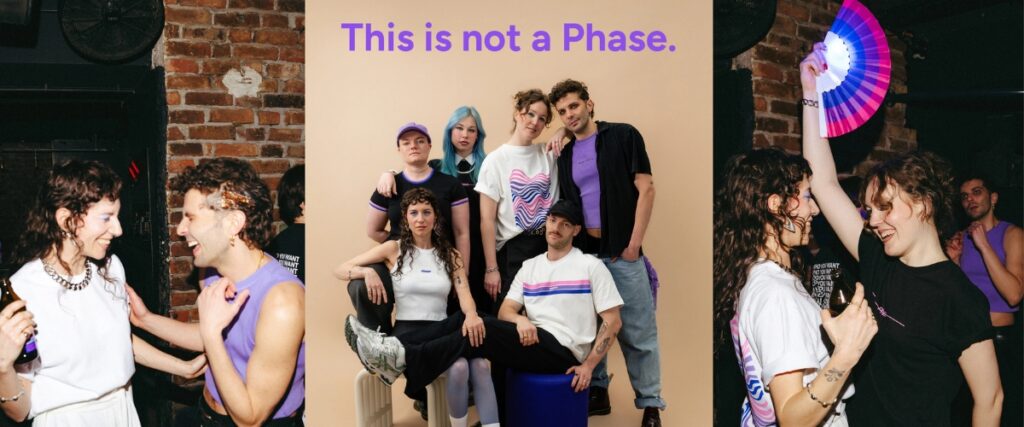
You could join an online group or Discord server, follow bi+ creators, watch queer films, visit Pride or go to a queer club night. These are all things you can explore at your own pace.
Meeting other bi+ people was one of the most validating things for me. But remember that not every bi+ person will feel like your person. If you attend an event and don’t immediately connect with everyone there, it does not mean you aren’t bisexual. It may simply take a little time to find your people.
And as much as I love bi internet culture, you do not have to be neurodivergent, cuff your jeans or struggle to sit normally in a chair. Those jokes create connections, but they are not admission requirements.
4. Coming out to yourself and others
Coming out starts with yourself. It means allowing yourself to acknowledge what you feel without immediately comparing or explaining it away.
You never have to come out publicly. But expressing the truest version of yourself can feel like putting down something heavy. You might tell one trusted person, bake a bi cake, wave a flag at pride, volunteer or express yourself through symbols, flag colours or even bi+ clothing.
You do not have to solve your sexuality like an equation. If bisexuality helps you understand yourself, try the word on. It might fit better than you think. And honestly, welcome – you belong here.